10 Mistakes First-Time Tractor Buyers Make
Buying your first tractor can feel complicated, but most costly mistakes come from overlooking a few practical details. From horsepower and attachments to storage, tyres and dealer support, here are 10 common tractor-buying mistakes to avoid.
Browse UHI TractorsThe 10 Most Common First-Time Tractor Buying Mistakes
Avoiding these mistakes can help you choose a tractor that better suits your property, workload and future requirements.
Buying your first tractor should start with understanding what you need the machine to do—not simply choosing the highest horsepower or the biggest tractor within your budget.
Overthinking the decision can make the buying process unnecessarily difficult, but rushing into a purchase can leave you with a tractor that does not suit your property or attachments.
The following mistakes are worth considering before choosing your first compact or utility tractor.
Start With the Right Tractor, Not Just the Biggest Number
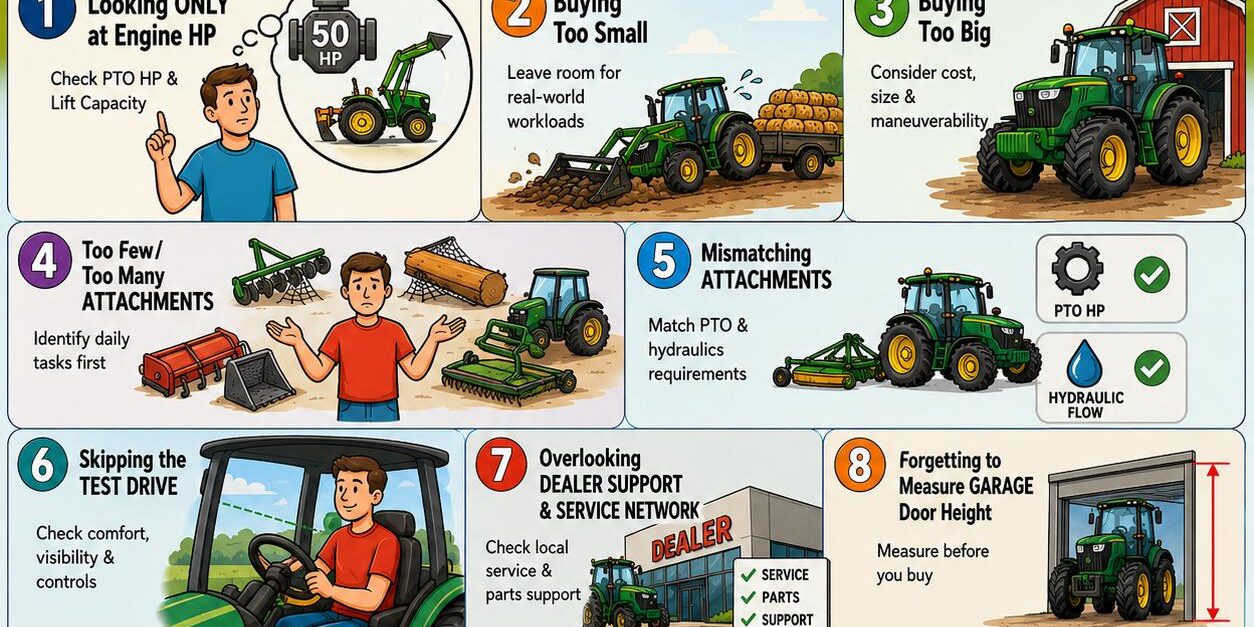
Looking Only at Engine Horsepower
Engine horsepower gives you useful information, but it does not tell the complete story about what the tractor can actually do.
Also consider:
- PTO horsepower for powered implements
- Hydraulic capacity and loader performance
- Lift capacity
- Machine weight
- Ballast and stability
Buying a Tractor That Is Too Small
Choosing only for today's lightest jobs can leave you short of power when you begin using heavier implements or loader attachments.
Consider whether your future work may involve:
- Heavier PTO implements
- Larger loader attachments
- More acreage
- Additional livestock
- More demanding property work
Buying a Tractor That Is Too Big
Bigger is not automatically better. Oversizing a tractor can create practical problems and unnecessary costs.
- Higher purchase price
- Higher fuel consumption
- Potentially higher servicing costs
- Greater ground impact
- Reduced manoeuvrability
- More difficulty around barns and orchards
Buying Too Few or Too Many Attachments
Attachments are one of the biggest advantages of tractor ownership, but buying without a plan can waste money.
Too few attachments may mean purchasing important tools separately later, while too many can leave expensive equipment sitting unused.
Don't Buy Attachments or a Tractor Without Checking the Fit
Mismatching Attachments to the Tractor
An attachment needs to match the tractor's specifications and connection system.
Before buying an attachment, check:
- PTO horsepower requirement
- Hydraulic flow and pressure requirements
- Tractor lift capacity
- Three-point linkage compatibility
- Loader capacity where applicable
Skipping the Test Drive
A tractor may look suitable on paper but feel completely different once you're in the operator's seat.
During a test drive, check:
- Control layout
- Forward and rear visibility
- Seat comfort
- Steering response
- Transmission operation
- Noise and vibration
Think Beyond the Day You Buy the Tractor
Overlooking Dealer Support and Service
The purchase price is only one part of tractor ownership. Parts, servicing and technical support can become very important after the machine starts working.
- Local service availability
- Spare parts availability
- Warranty support
- Technical assistance
- Dealer proximity
Forgetting to Measure Storage and Entry Height
Tractor dimensions are easy to overlook until the machine arrives home and does not fit through the gate, shed or garage opening.
The Roll-Over Protective Structure (ROPS), cab and attachments may make the tractor significantly taller or wider than expected.
- Garage door height
- Shed entrance height
- Gate width
- Overall tractor height
- Attachment width
Ignoring Your Future Needs
Many first-time buyers choose a tractor for their current workload and discover later that their property or farming operation has grown beyond the machine's capability.
Think about whether you may add:
- More acreage
- Additional livestock
- Heavier attachments
- New agricultural jobs
- More regular tractor use
Choosing the Wrong Tractor Tyres
Tyres affect traction, ground disturbance and how comfortably the tractor performs on different surfaces.
| Tyre Type | Best Suited To | Main Trade-Off |
|---|---|---|
| R1 Agricultural | Mud, paddocks and applications where maximum traction is important | More aggressive tread can disturb lawns and softer turf |
| R3 Turf | Lawns and applications where reducing ground disturbance is important | Less traction in wet or demanding conditions |
| R4 Industrial | Mixed property work, loader applications and general-purpose use | A compromise between turf protection and agricultural traction |
Before You Buy Your First Tractor
A good first tractor should match your work, property, attachments and long-term ownership requirements.
Choosing Your First Tractor?
Think about your property size, daily tasks, attachments, terrain and future workload before selecting a model. UHI offers tractor options for different Australian farming and property applications.